Ever since I was a kid, I hated performing. The lights were always too damn bright, and I suffered from terrible stage fright. You know, the kind that gets you all clammy and tense and your fingers get stiff. Then you miss a note nobody noticed, a pang of anxiety blasts through your entire body and you mess up again in a never-ending cycle. Or maybe you don’t know; imperfections aren’t common these days. I suppose that’s what changed my mind—the fool who refused the shortcut. Mistakes are who I am. Perfection is earned. At least that’s what I tell myself when that anxiety sets in again. Never quite outgrew it.
Tonight was no different, even with my special guest. I felt a cold sweat, my dress was uncomfortable, I couldn’t quite sit right. But with a deep breath, I still placed my fingers on the ivory keys and pressed them gently to reaffirm their weight. I slouched behind the piano, pretended the audience didn’t exist, and I began to play. It was a sad song—a dance of long, sorrowful chords and the patter of staccatoed raindrops. Time melted away as I lost myself in the melody’s flow; I had become a part of it, my hands moving across the keys with the same fervent melancholy I felt when it was written all those years ago. Memories of broken glass and sunken lives filled my mind, and the song reached its end.
Applause boomed like thunder in the room. They had loved it. With a swelling heart, I should have stood to face the audience, but something was wrong. I felt dread, my stomach sinking, my back hurting. All at once, the applause abruptly ceased. The room was silent, the lights grew dark. I gripped the sides of the bench and gathered the courage to stand, and behind the baby grand sat phantoms. My parents, my brother, my coworkers—all silhouettes of pitch against white chairs. Hana was nowhere to be seen. Panicked, I scoured my hair for its ribbon tie. It was down.
I jolted awake. Literally. “User stress was detected above maximum threshold,” said a robotic voice. “For your psychological safety, a mild shock was delivered to reinduce consciousness. We apologize for any inconvenience. Thank you for using Somnus®.”
“Yeah, yeah…” I grumbled as I removed the electrostimulants from my ears. The little pods fell to the floor where the robot lady started talking again, but I paid her no mind. My back was killing me.
I had fallen asleep at the piano again, its white display the only source of light in my dark apartment. A picture frame laid face-down on the keys next to me. Half-written papers of sheet music were strewn about across its metal surface, on the floor, I had even used one as a pillow. My spine cried for mercy as I groggily stood from the bench. Stretching and regretting, I felt my mind slowly waking up. “Hana’s ribbon,” I thought and combed through my hair. Nothing. My stomach sank again. I snapped my fingers to turn on the lights. The drastic change almost evaporated my feeble eyes. But as they illuminated my unmade bed and scattered clothes, so too did they reveal the red string tied snugly around my wrist. “Thank God…” I mumbled, now feeling a strange emptiness. I grabbed the picture on the piano almost out of reflex. It was her and I, all smiles, taken at Water’s Edge. Fujisan towered behind us, snow-capped and resolute, beautiful. Hana looked healthy, and I looked happy. Those were better times, before the bombings, the economic crisis. Before… that’s right.
Now I knew I was awake. Every morning played out the exact same. I would wake up, my mind smothered in dense fog. Slowly, but inevitably, it would recede and I would remember everything. Kawamoto Hana was dead. Those joy-filled days of music and mountains felt more a distant dream than any memory. I gazed at our smiling faces, spilling no tears. I wish I could cry, more than anything I needed that cathartic release, but this was no fairy tale. The stars did not fall like tears from the heavens, nor did the mountains crumble to dust. Reality continued as normal: the bills still came, the bombings still continued, and Fujisan stood all the same.
Presently I had no time for wallowing. I had places to be — people to see! Or so to speak, anyway. Fritz had invited me and the other employees over for one last dinner together. “Friday night seems as good a time as any to say goodbyes, eh friends?” he had said. I suppose he’s right. As good a time as any to lose your job, too.
I needed a shower.
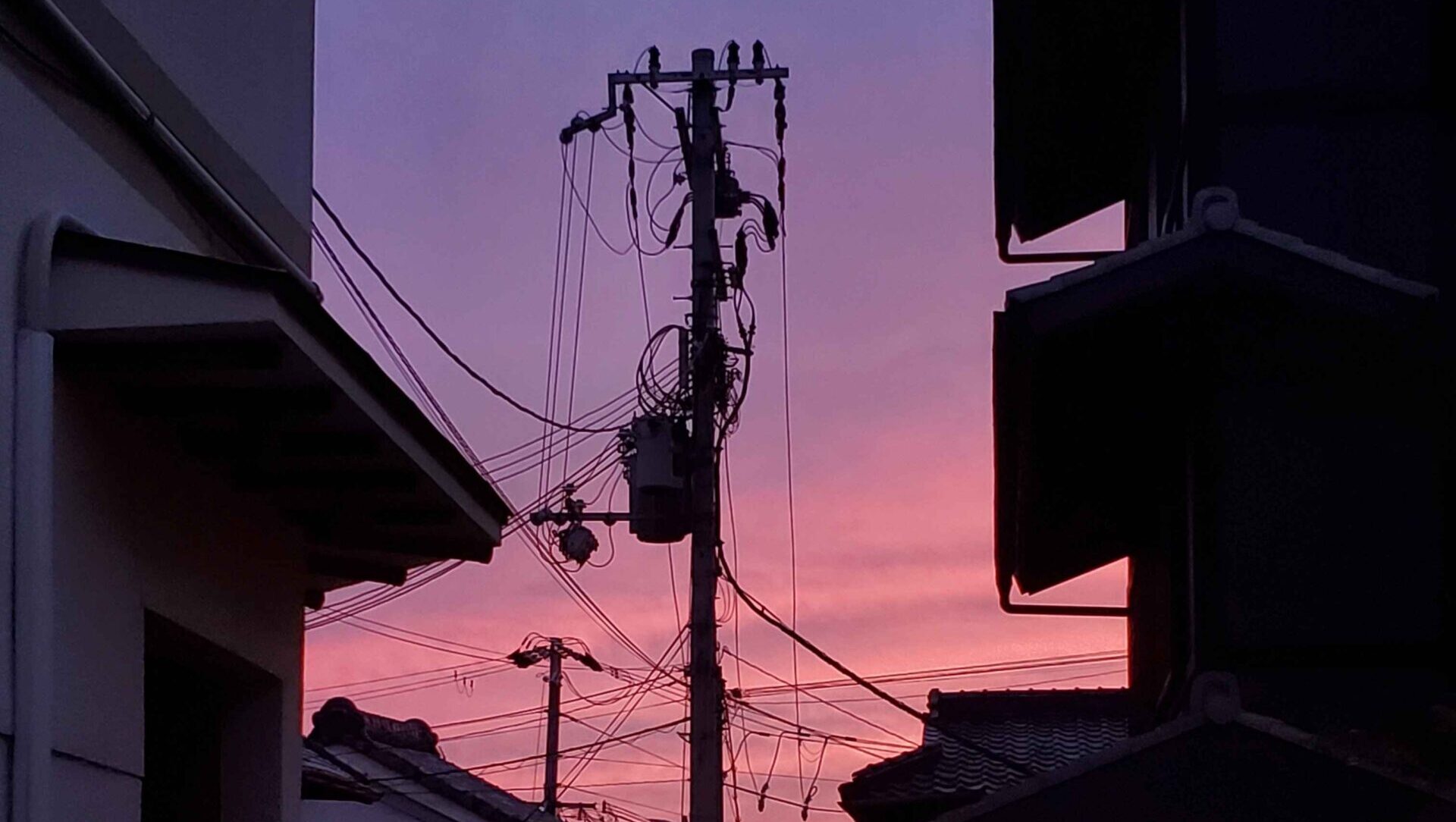
Tonight’s was an uneventful journey. The train was crammed, the crowds faceless, the buildings drenched in neon. The sky bathed in a sea of pink and blue, where fluorescent clouds hid the moon’s pale glow. I always felt disappointed when the stars were smothered like this, and Hana would call me too brooding. I should appreciate the cotton candied heavens! Not tonight, old friend. Not until the sting was bearable. Besides, the ground was inviting enough.
It wasn’t long before I came along that innocuous alleyway—a narrow space between an old apartment highrise and KasuCorp’s regional offices. At its end beamed fluorescent Western lettering and kana, shades of red and white that read: “København: A Taste of Denmark”. The storefront was rustic, inviting; it wasn’t often you saw a wooden door or old French-style windows here in Tokyo. I loved those windows. Light felt warmer in them.
A bell rang as I opened the door and stepped inside. Fritz and Adrianna were sitting at the long table behind the bar, and Rahul was shouting something in the kitchen. It was a strange sight. I’d never once seen the bar completely empty—bottles, glasses, everything was just gone. Even the piano. Fritz had already told me about it, but actually seeing my little stage empty was a strange feeling. I felt I had lost something.
“Akari!” my boss shouted in welcome. “Glad you could join us tonight. I got water and lemonade for you here. Take your pick.”
I hung my coat on the back of a chair and took a seat. “Lemonade, please,” I replied.
“Coming right up!” he said, and he stepped into the kitchen.
The table was decorated by a few glasses and a half-empty bottle of gin, but the air smelled more like cinnamon and rye, not alcohol. It was just me and Adrianna sitting in silence, and I tried my best at small talk.
“It’s, uh, cold tonight, huh?”
“Yeah,” she replied curtly and avoided eye contact.
“Yep… yep.” Conversation over. Masterfully done, Akari.
“Oh, hi Akari!” I heard Rahul shout from the kitchen. He and Fritz stepped out shortly thereafter, my boss carrying a glass of sparkling liquid as golden as his hair, and my coworker fiddling with a scarcely recognizable potato. Two metal electrodes had been stabbed into its surface, connected to a mass of wires. Something straight out of a pre-corp science fair.
“It’s good to see you, Rahul,” I said. “And your potato.”
“Trust me, Akari, you won’t believe your eyes when I show you this thing. Actually, you won’t believe my eyes,” he said with the most obnoxious, endearing grin I had ever seen.
“So I was plugged into the Ether, right? Just messing around in the research section of Neo-Alexandria. I came across this paper on standard optometric implants — iris coloration, to be specific. These are biomechanical, so still organic, but there’s a few mechanisms that can respond to the right input of electric current, including the light scattering nanoplates! So I got to thinking. What would be a cool party trick? And bam. Potato. Novel enough, but more importantly, this setup delivers just the right amount of current to not make them explode.”
“Then it would seem a demonstration is in order,” said Fritz.
“Say no more,” Rahul replied. Opening his eyes wide, he took the exposed ends of each wire and connected them at an open port on his biomechanical hand. Sure enough, after a faint spark, his eyes started to change color — from dark brown to green, dark blue, and finally stopping at light blue. “Tadaaa! Now I’m Fritz.”
“Amazing,” I said with complete sincerity. At least Adrianna was smiling again.
“I guess that’s why Kasu R&D picked you up, huh?”
“Maybe. More likely they scouted me because I worked for a Synth.”
Fritz chuckled at that. “Perhaps,” he said, and spun his now empty glass on the surface of the table. “On the topic of employment—any news with you, Adrianna?”
“No luck,” she said. “I’m probably going to have to move back with my folks in Arizona. They run a shop outside Phoenix.”
“Out in the boonies, right?” Rahul said, his eyes back to their normal brown.
“Yeah… I’m not looking forward to it. You’re lucky to get a day where it’s less than 130 out.”
“Well, at least you’re with family,” Fritz tried to be sympathetic. “Should make it a little more bearable.” She didn’t reply.
“What about you, Akari?” Rahul started. “I imagine you’re sticking around.”
“Probably,” I said. Truthfully, I didn’t want to talk about employment prospects, but I felt I owed it to them to be friendly. “I put a few ads out on the Ether, and got a few responses.”
“That’s great!” Fritz said.
“Not really.”
His brow furrowed in a mixture of confusion and concern. “What do you mean?”
I felt bitter. The kind that festers every so often, turns to anger and boils over. “Corporate bigwigs put in an ad asking for a night of ‘private tutoring’ in their vacation penthouses. I don’t think you have to be very smart to infer the implication, but it’s a good enough excuse for someone with reputation on the line. Some of the offers were ludicrous. Two months’ pay in a single night.”
“Jesus. I know money’s been tight for you lately and all…” Rahul said, trying to be sympathetic. “It must’ve been tempting.”
“If Hana hadn’t begged me not to, I’d have done it a thousand times.” The room fell completely silent at the mention of her name. I looked at the faces of my coworkers—my dear friends. Their eyes were filled with pain. It would seem I had finally addressed the elephant in the room.
“I’m so sorry, Akari,” Adrianna finally said to me. Her voice was quivering and tears rolled down her cheeks. “It’s just too awful. All of it. It’s not right. And nothing I say or do will make you feel any better.”
“She was your friend too,” I said as a wave of guilt began to take hold of me. “Don’t worry too much about me. You have to grieve too.”
“Don’t worry about you?” Rahul rebuked. “Have you looked at yourself recently? Showing up late, never smiling, your eyes baggy and cold. You’re good at hiding it, I’ll give you that, but I see how you hurt in them. Please don’t think you need to handle this alone.”
“I have to, whether I’d like to or not,” my voice began to tremble. “I wanted tonight to be normal. Old friends enjoying a drink and each other’s company—not playing therapist because one of them can’t keep her mouth shut.”
“Akari—”
“I’m never going to see any of you again. Don’t you get it?” Tears were spilling now. “Who knows what Adam is gonna do to Fritz after they recall him? Wipe his memories? Toss him in the trash? Tonight is for him, not me.”
Fritz was quiet, swirling his half-finished drink with his right hand, resting his chin on the fist of his left. His ‘thinking pose,’ Hana called it. He sat like that for a moment, then opened his eyes and smiled gently. “If there’s anything I have learned in these past 5 years,” he started. “It’s that I have nothing to fear.”
“I don’t understand…” I replied; which was to say ‘what the hell are you talking about?’
“When I first heard our dear friend had passed, I did not know how to process it. Death as a concept is a strange thing to me. Apparently I have experienced it before—the original Fritz died in 2082—but the people who created me only used him as a template. My, his, memories were wiped from my databanks, and no matter how hard I try to conjure them into conscious memory, I fail.
“For better or for worse, being artificial casts death in a different light. People believe in souls, in an afterlife for the righteous; but as a being that was constructed, unnatural… I began to wonder if there was room in heaven for someone like myself. Death seemed so permanent and absolute. If one day, my batteries died with no one to help me, would I forget all of you, my dear friends? Would these memories be scattered like ashes to the wind?
“Akari, I sense that in your grief that you are plagued by a similar question. If it is okay with you, may this strange old man be permitted a chance to answer it?
I gave my answer immediately.
“Of course.”
“When the researchers at Adam sent me here 6 years ago, it was part of an experiment. ‘Could a Synthetic Human integrate into society? Could they form relationships? Run a business?’ Those were the questions that I was to answer by being myself. But when I first came here, I was unsure of who ‘myself’ was. That was the question I truly sought to answer.
“For many weeks, I aimlessly wandered this city. I hoped to find a glimpse of myself in its bright lights and tall buildings, but there was nothing to be gleaned from them. Nevertheless, I drifted about, and one night I found myself in a beautiful little bar at the end of an alley, not unlike this one. I sat at the counter to order a drink, and only then noticed that across from me sat the most beautiful woman I had ever seen. Golden hair, bright blue eyes, and a smile that stirred my metal heart—as silly as it may sound, something told me ‘I must talk to this woman.’ And so I did.
“She was as lovely as she was beautiful. We spoke and laughed the whole night through, as naturally as old friends. But circumstance was cruel, and my overseer bade me return home before I could learn her name.
“For days I wondered about this woman and her significance to me. For the first time, I began to dream. We were married, had a daughter, and lived happily in a tiny little house in a tiny little city. These dreams were more vivid than reality—brighter, more colorful—and the love I felt for these two was stronger than any emotion I had ever experienced. It was not long before I realized that these were not, in fact dreams, but the memories that had been taken from me. Karla was my wife, Fritz Larssen’s wife, and Frida was our daughter.
“With this realization, I had to return to that bar. Karla died shortly after Fritz did; how could I have met her that night? I returned to Shibuya, nearly ran through the crowded streets, and finally came upon that same alleyway I had chanced to wander down that fateful night. At its end stood not a bar, but an old wooden house, rotting and empty. I checked my memory banks to confirm my location. It was correct. This bar never existed.
“Long I’ve wondered if Fritz and I were the same person. I have concluded that we are not. We are different, our experiences different, the people we love have shaped us into different people. And yet… there is something inseparable that links us. Something that has transcended time, space, and death. Perhaps I’ve a few screws loose, but to me this is truth. I love my wife and child more than anything. And should Adam choose to wipe the memories I’ve gained here in the Far East, I do not fear it. For even if I should find my new self in a distant place, in a distant time, I shall know you, my friends. I shall love you all the same.”
In these five wonderful years, I had never once thought of Fritz as anything less than human. His kindness, gentle smile, and glowing laugh had left a profound mark on my heart. This fact was never once in question. Yet if there was one thing I always wondered about him, it was that I had never seen Fritz cry. Was someone like him even capable of tears? As those final words left his lips, I had my answer. The droplets spilled from his eyes, fell upon the table like glassy rain.
“My friends. Do not fear what lies on the other side; not for me, not for Ms. Kawamoto,” he wept. “We are all little ripples in the lake of time, memories cascading forever toward its edge. One day, on some distant silver shore, we shall meet again and know.”
Fritz Larssen was more than human. His words had moved me, moved all of us. The company of four sat in the warm silence, each wetting the table in their grief. But it was right. This was camaraderie in its truest form. All things must come to an end, however abrupt.
The night grew late. Adrianna gave me a case for Hana’s ribbon, and Rahul a metronome suspiciously lacking in potato batteries. I was touched by the gesture and felt guilty I had not thought to return it.
“Think nothing of it,” Rahul said. Adrianna answered in her own way with a tearful hug. I thought she might squeeze my soul out of me, but I endured and returned it twofold. Fritz and Rahul soon joined the fray, and for the first time since Hana had passed away, I felt something like happiness. After a bit more talking, each of us said our final goodbyes, threw on our coats, and made our way to the door.
As Rahul and Adrianna stepped out into the night, I felt Fritz tap my shoulder.
“There was one last thing I wanted to tell you before you go,” he said and stared at his feet. “It’s about my daughter. Would it be too much trouble?”
“Of course not.”
“Excellent.” He seemed to relax. “In my memories, she was just a little one. Maybe seven at the oldest. Fritz and Karla passed when she was still very young, and I’ve always worried about that fact. She would be about your age now.
“You and Ms. Kawamoto are such bright young women. I think the two of you would have been good friends with my Frida. I wanted to thank you two for that—for reminding this strange, old man what it means to be a father.”
He smiled.
“Please take care, Kobayashi Akari. Until we meet again.”
“Until we meet again,” I said, and stepped back into that alley for the last time. The city lights gleamed at its end. As I began to walk toward them, a bell rang behind me, a door closed. The French windows lost their light, and Tokyo would forget its little taste of Denmark.
When I was growing up, my family had a big pre-corp kotatsu the four of us would sit under on cold nights. It was truly a gift from the heavens. We’d snuggle up together under the heater beneath the table. Sometimes we were eating, or mom would be telling stories, or all of us just sitting there in silence. I remember when Yuuto was silently working on homework, I would drum my fingers across the surface like they were piano keys. It probably didn’t help with practice that much, but it was a good way to pass the time.
For all its virtues, the kotatsu had one fatal flaw: at some point you had to leave the warm embrace of the blanket. Sometimes you would be lucky enough to dive back under right away, but most of the time you weren’t. And the world feels so much colder when you were just somewhere warm.
It was raining in Shibuya. Drops of liquid neon fell upon the concrete, formed pools of pink and blue. I saw cotton candy in them, and the ground seemed less inviting. The ribbon in my hair hung heavier. My family was gone. My friends were gone. København was gone.
As I continued walking alone, I felt empty. It was not a feeling of overpowering emotion, but a lack thereof. Some fundamental part of me was missing. There was a gaping hole in my heart, and it yawned wider with every labored step. The cold was unbearable, the lights were too damn bright; I couldn’t look at the ground or sky without thinking of her.
I blindly turned a corner, no longer caring about where I was going. I meandered like that for what seemed like hours, half in a daze. And when I finally gathered enough of myself to face reality, it seemed fate had half a mind to mock me. Ahead of me stood a building; what was left of it anyway. Twenty days ago, a group of ecoterrorists planted a bomb within Devox HQ. Three-hundred employees and fifty bystanders were killed, including seven of the fifteen corporate executives inside. The casualties were so grave that medical supplies across the entire city had to be thinned to accommodate the wounded.
The building had been reduced to a gnarled mass of concrete and rebar, a grizzly sight of a mass murder. And on its Eastern face hung a freshly installed advertisement panel, jutting out even above where the building had collapsed. A woman with bright pink hair and lavender eyes danced across the digital screen, two electrostimulant pods generously highlighted in her ears. “Somnus®: Take control of your dreams.” Repeat.
It didn’t matter. Nothing mattered. Left, right, forward, backwards—the same flurry of fluorescent vanity assaulted me regardless. It was inescapable, this blatant exploitation. It had taken everything from me.
I had long wondered what those executives saw in me when they answered my ad. I was a plain girl with a useless talent—no pink hair or purple eyes. One of them had told me I had “natural beauty,” which is what you tell a girl when she’s a little ugly. But that was exactly it, wasn’t it? I had refused augmentation so that my skills would remain my own. To me, that meant my identity. But to those men, that was a kind of virginity. I was “natural”, “unused”—that was my appeal. The culmination of my hopes and dreams was to be used as nothing more than a pretext. I was an item to be gawked at for a moment and tossed aside.
Hana, Fritz, my family—it was all the same. At best, we were items worth using, at worst our lives were stepping stones along the path of the powerful. Devox was bombed for their crimes against humanity in West China. Every one of those executives deserved a fate worse than what they got, but for those who survived, they would be fine. If these vile people lost an arm or a leg, they would get a new one without worry. Their influence saw to that, and whatever suffering they would endure was pushed downwards. Hana had to take a “Social Utility Examination” to determine if she was even worth keeping alive. She scored a 6 for a history of repeated hospitalizations, and all the doctor could do was say “I’m sorry.”
I wanted to believe you, Fritz. More than anything, I wanted to feel that you were right. That I would see you all again. But the lights and sounds and everything was too much. I started sweating as I walked. I couldn’t breathe. The lights were burning me out of existence. I would disappear, and no one would remember me, or you, or Hana, or your daughter.
I pulled the ribbon out of my hair and clutched it to my breast. Every block I passed, I felt myself slipping further, feeling fainter. I gripped the ribbon as tightly as I could and spoke to her.
“I’m so sorry Hana. Please help me. Please don’t let me fade away.”
I was too afraid to stop. I had no idea where I was going, but I just kept walking and sweating and begging and choking. There were still no tears. That gnawing void in my breast was pulling me in. I was teetering at the brink of something unspeakable, and the only thing that held me in place was a crumpled strand of wet fabric.
It was not out of conscious decision, but pure desperation that I found myself at the doorstep of that bright building. Flashes of warm light, a heartbeat of incandescence, pulsed from behind tinted glass, cast long shadows across the empty streets. Placing Hana’s ribbon in my pocket, I stepped into the Dreamer’s Lounge.
The inside was flashy, loud. A pale-blue cloud of sadness and nicotine enveloped the place, almost as stifling as the robotic beats of the pop music booming in the background. A woman about my age sat at the front desk, quietly smoking a cigarette. Her hair was as blue as the sky, and her xenon irises beamed a deep purple. As an exhale of violet miasma escaped her lips, she noticed I had entered. Her eyes literally lit up, and she extinguished her cylindrical vice in an ashtray hidden behind a computer monitor.
“Welcome to the Dreamer’s Longue!” She greeted me with a smile. “How can we change your life tonight?”
The two of us went through the motions. I told her I wanted a pod for a few hours. So she asked my name, date of birth, social identification number; she chewed the tip of a pen as she entered everything into the computer.
“No history of psychological issues or conflictory augmentations, social credit score in good standing. Everything seems to be in order!” She smiled again and opened a drawer, pulling a few papers and an unchewed pen from within. “I’ll just need you to sign this. A liability form in case you have lasting psychological damage. Nothing to worry about though. Sign here, here. Initial here, mhm, and date here. Alright, you should be all set. I’ll take you to your pod.”
She stood up and gestured for me to follow. We weaved through a forest of plastic, people housed within each tinted ovoid. I could just make out their forms, all shadows, hear muffled sounds. Some were reaching out toward something that wasn’t there, others were laughing or sobbing, a few were thrusting their hips. I just placed my hand in my pocket and followed my guide.
“Here we are!” she said as we arrived at an empty shell. “Go ahead and lay down and I’ll strap you in.”
Following her instructions, I crawled onto the comfy leather recliner on the inside. She fiddled with some wires at my feet for a moment, then hopped up with two in hand. “Put these in your ears. Here. This one’s the left. You’ll feel a little tingle, maybe a jolt, but it’s fine. Make sure to think about what you want to dream about! It’s like a snapshot, right?”
With the electrodes properly in place, she shut the door. I closed my eyes, kept my arms straight at my sides, the ribbon safely held in my right hand. There was a hiss. The pod began to fill with gas, my mind did too. I tried to think of Hana. Of everything. But it was all too scattered. I was tired. “Sweet dreams,” I heard the woman say. Then came a shock, and darkness.
What I experienced was somewhere halfway between dream and memory. Lucidity ebbed, then flowed, never once breaking through the fog that shrouded my mind.
I was Akari, the little girl who sat alone in the back of a dark classroom. Scribbling in a notebook I had repurposed into sheet music, I filled in the circles and tails of whatever notes came to mind and hummed them softly to myself. It was a familiar melody, one I wrote for Yuuto to play for a girl he liked. I could never quite get it right though, and when the frustration began to set in again, so too did that inescapable truth. Yuuto died last month; mom and dad too. Blown to bits. They would never hear this melody.
I put my pencil down and checked the time. 4:18pm; I wondered when the Principal would come to kick me out again. The classroom door loudly slid open, filling the room with a blinding light. Seems I was right on the mark.
I looked up to meet the balding thorn in my side, but was met by something else entirely. A girl, short and frail, stormed toward me. Two red ribbons streamed in her hair as she walked, and a single paper was clutched tightly in her hand. She reached my desk faster than I could sit up, slammed the paper on its surface.
“What is this?” she questioned indignantly. A quick glance revealed they were the class rankings from our midterm exams.
“Our test scores?” I said confusedly, and she glared at me as if I was supposed to say more. “I don’t understand the problem. It says here you still placed first in our year.”
“That isn’t the problem.”
“Then I’m not following.”
She pointed at my name at the bottom of the page. “You’re eleventh. You dropped nine places.”
I laughed nervously. “So?”
“You’re better than that.”
The hell was this girl’s problem? We talk a couple times, and now suddenly she acts like my mom? “What’s it matter to you?” I snarled. Only then did I notice she was trembling.
“Kobayashi—” she started as tears began to spill from her eyes. “I’m worried about you. Everybody knows what happened, but they don’t say anything. Every day you sit here alone in the dark. You don’t talk to anybody. You’re so quiet, I can never tell if you’re sad or lonely or afraid. And then—then this.” She reached for the scoring page, now wet with her tears, but knocked it onto the dirty floor instead. Her face burned red and her tears fell faster.
I was stunned into guilt-ridden silence. “I still don’t understand,” was all I could muster. “Why do you care?”
“Because I care about you, Kobayashi. Can I say that? I’ve always been intimidated by you, but you’re the closest thing to a friend I have—quietly pushing me to do my best. Do you know how much that means to someone like me? In the last few weeks I’ve seen so much pain in your eyes. You need someone right now, don’t you? You can’t handle this alone.”
In sheer bewilderment, I finally looked at this girl head-on. Her entire body was shaking, her face was flushed red with embarrassment. Yet despite every indication of her fear, her misty brown eyes remained fixed with mine, so full of fire and earnesty. The light around her burned warmer, radiant, and for the first time since losing my family, my heart stirred.
“I guess you’re right,” I said, unable to make eye contact as the words left my lips. As I turned back toward her, there was nothing. The classroom door had silently slid shut, and the classroom was filled with darkness once again.
“That’s right,” a voice spoke to me. “You need someone. You need someone and you’re alone.”
Suddenly feeling afraid, I stood up from my desk and rushed to the door. It was ajar and I could see light beyond the crack, but it was wrong. It was like a ghostly projection, pale and flat, that clung to the darker walls as if to hide from me.
“Kawamoto?” I called out like a lost child as I stepped outside. The corpse-light flickered, illuminating nothing. Whatever this space was, it wasn’t the hallway.
“You know where you are. Don’t kid yourself.” Said the voice, my voice. “Look.”
In front of me was a hospital bed. The room was filled with the sounds of whirring machines and labored breathing. With every strained breath, the crumpled sheets would rise and fall, rise and fall, incessant. I know not what compelled me to do so—I never wanted to see this again—but nevertheless I approached her side with surety, and reached to remove the cloth covering her face.
It was Hana. Her skin was sallow, her eyes were sunken and grey, air was scarcely drawn in by her cracked lips; and she was so thin, like a withering flower. Even in dying delirium, she seemed to know my presence. Her vision had long since faded, yet she stared at me with bright eyes, spoke in desperate croaks: “Ah… ah… ah…”. There was an urgency in it that I didn’t understand, but I could see her struggling to move her arms toward me. “Ah…ri…”.
I moved the blanket yet again, exposing her naked body. Cupped in her bony hands flickered a tiny flame, more an ember, and she cried now as she gestured for me to take it. I reached for it gently, worried I might hurt her with even the gentlest touch. But as I gazed into that crimson, I saw reflections, memories of days past. My smile, my tears, my pain; all of it was there, burned away the veneer of illusion. I remembered who I was, the pain in my heart, and so for the slightest moment I hesitated. The kindling choked, and both Hana and the flame faded into nothing. I was alone.
The ghostly lights flickered again and again, each time revealing a different nightmare. First it was a little girl, terrified of what laid scattered in the street before her, chunks of concrete and flesh; she wondered if parts of her family were among them, and the void yawned wider. Fritz was there next, alone in a glass prison. Machines beeped and whirred around him, and his brain had been pried open by a jungle of wires and tubes. He was pleading to his wife and daughter as the scientists shook their heads. “I’m sorry. I’m sorry.” With an impatient sigh, a man pressed a single button, the monitor above him went blank. Fritz died, and the void yawned wider. Again I saw myself, a shadow in a plastic pod. I had lost myself to the dreams, become addicted to their lies. Akari the shadow called out the names of people who no longer existed, reached out to hold those that were no longer there, and the void yawned wider.
When the lights next dimmed, they did not return. I was alone in the consuming dark, as I would always be, I realized. People like Hana, like Fritz, everyone else—so blinded I was by their warmth and radiance, that I never realized the light I had blanketed myself in was borrowed and never my own.
That’s why, isn’t it? When alone those stage lights, the neon signs—they always felt too damn bright, like they were burning me away. Alone, I am a void, empty and hollow. Alone, I am nothing.
I reached for the ribbon in my pocket as if by instinct. The fabric felt warm as I threaded it through my fingers. The sensation was grounding, comforting; I pulled Hana’s gift out of my pocket, held it in two hands against my lips. I thought of how she gave it to comfort me in those days: “a symbol of love that transcends lifetimes.” It was so like her. She had been dying, yet her thoughts were ever about me.
“Your flame,” I whispered. “I let it fade away.”
Then the ribbon ignited, the fire as vibrant as the fabric that fueled it. It did not burn, it did not shrivel; it cast away the shadow and saved me.
“Hey Akari,” Hana said while laying on my bed. I was sitting at my piano, scribbling something down as she spoke. “Do you mind if I scream into your pillow really quick?”
I laughed and put my music away. “No, I don’t mind. What did you remember this time?”
She had already buried her face into the pillow, and I could barely make out what she said. “Mmh fir comsaton wifu!”
“What?”
“My first conversation with you!” Her face flushed pink as she craned her neck, and remained that way as her head fell defeated back onto the bed. “Could I have looked any more stupid?! I had practiced it in the bathroom mirror a dozen times—I had it down to a science—but when the time came to actually confront you, I couldn’t stop shaking. I looked at you and…”
“And what?”
Her face somehow got redder. “I couldn’t stop thinking about how pretty you were. How pretty and sad. And then I started crying, and oh my god, it just never got better, did it?”
“I admit I was confused at first, but it really was endearing, Hana.”
She looked at the ceiling as she spoke. “Yeah. I’m still glad I did it. You know why?”
“Nope.”
“I just felt I should!” She giggled. “Well, it was more like something telling me, ‘Hana, you need to help this girl.’ And so I tried in my own stupid way.” She turned to look at me, her brown eyes meeting mine in that dimly lit room. “You were a star burning out in the night sky. Like if I looked away for just a second, you would be gone. But that little heavenly flame had left a mark on my heart, and however foolishly, I felt I needed to keep it from disappearing.”
“A star, huh? Not like a neon sign?”
“Not at all. There’s different kinds of lights, you know? Neon is bright, colorful, but that’s it. There’s no warmth to it—no substance beyond excited electrons. But the whole city bathes in its glow, every day, every night. Even the rain seems so blinding.
“But there are those rare nights you can see stars poking out from behind the cotton-candied sky. Even if just for a fleeting moment, they shine resolute in a sea of neon — dazzling and beautiful and warm. In that way, I guess I’ve always seen people like you as stars, passing into my life for a short moment and reminding me what it means to live.
“The world sucks, you know? My mom, my illness, your family and career—all of our hurt, our loneliness, it’s a part of a neon world. A vicious place of selfishness and vanity, where bright lights only serve to obfuscate, not illuminate. Where people like you and I have forgotten what stars look like.
“But I met you, a lonely star shining in the back of a dark classroom, and I remembered. You have brought so much joy and meaning into my life. The world is a terrible place, but incredible people are a part of it. If I hadn’t remembered, hadn’t taken the leap and humiliated myself that day, would I have ever known this happiness?
I was speechless. She was so passionate as she spoke, so earnest. I knew she meant every word, but still I felt unworthy. My heart ached, I still doubted myself. How was it that kindness could hurt so much?
“Akari? Is everything alright?” Her face was full of concern.
“Yes,” I said. “I just… I don’t think I deserve it. Your praise, I mean. I’m broken, selfish. I’ve been nothing but a burden on others. And for what? Pride?” My hands were trembling. “If I just accepted an offer from any of those men… you wouldn’t have died. You’d still be alive. I could be having this conversation with you, the real you! I wouldn’t be alone anymore. All I ever needed was you, and I let you go. I let you burn up.”
Without a word she slid out of the covers, took a few steps toward the piano, and embraced me. Her arms were locked around my back, her hair smothered my face, and I could feel her gentle heartbeat against my chest. “It’s not your fault,” she whispered. “Nothing was your fault. It’s not your fault.”
In that place beyond the neon rain, blanketed in the warmth of a lost love, a dam finally burst. For the first time since I was a child, I wept. With heavy tears, sobs that shook my whole body, years of suffering spilled into Hana’s arms. But still she embraced me, gently saying “everything will be okay.” And this time, I believed her.
Time went by, and the tempest in my heart began to subside. Sensing my calm, Hana kissed my head and stood up again. From the look on her face, we both knew we were out of time.
“I’m going to miss you,” I said with a still frail voice. She leaned down once more to kiss me. It was short, but passionate, and her lips were warm.
“I will too,” she replied. “But we’ll meet again. That much I know.”
She walked to the door, stopping just as it began to creak open.
“Oh, and Akari?”
“Yeah?”
“There are people out there who need you—people who you need. Promise me you won’t be afraid to find them.”
“I promise.”
With that she opened the door and stepped into the stars behind it.
“I’ll be seeing you then,” she said. “On ‘distant silver shores,’ was it?”
Before I could reply, I felt a shock in my ears, and with it, the dream melted away to the song of Hana’s laughter.
I walked along the unfamiliar river of an unfamiliar city. Colorful buildings lined the bank, far cuter and smaller than the corporate edifices I was familiar with in Japan. I glanced back down at the paper in my hand and wished my handwriting wasn’t as terrible as it was. Did it say 5724 or 5729?
I stopped at the little blue apartment building whose number matched my notes and stepped inside. The floors were made of wood and creaked as I walked along them, and the place was filled with the nostalgic scent of cinnamon and rye. After winding through a series of noisy hallways, ascending a few flights of noisier stairs, I had arrived at my destination. Apartment 5724… or maybe 5729. I guess we would find out.
My heart was pounding, and I found it difficult to gather courage. Remembering my promise, I reached into my pocket and removed a red ribbon, lightly charred around its edges. Comforted by its warmth in my hand, I knocked on the white door and waited.
A tall young woman greeted me as it opened, her hair was golden like the sun, and her eyes were as blue as ice.
“Can I help you?” she asked.
“Uhh, yes,” I stammered. “Is this the residence of Frida Larssen?”
“That would be me.”
“It’s nice to finally meet you Frida. My name is Kobayashi Akari.” Another deep breath. “I’d like to talk to you about your father.”
December 2, 2020

Leave a Reply