Ever since I was young, I have been told I possess a photographic memory. True enough, I do have an affinity toward remembering certain information—the names of animals, the definitions of words, the molar mass of common elements—but by no means does this imply I remember my experiences well. Here, my memory is frustrating unreliable. There is no better illustration than my first memory, which I have held dear, quite literally, for as long as I can remember.
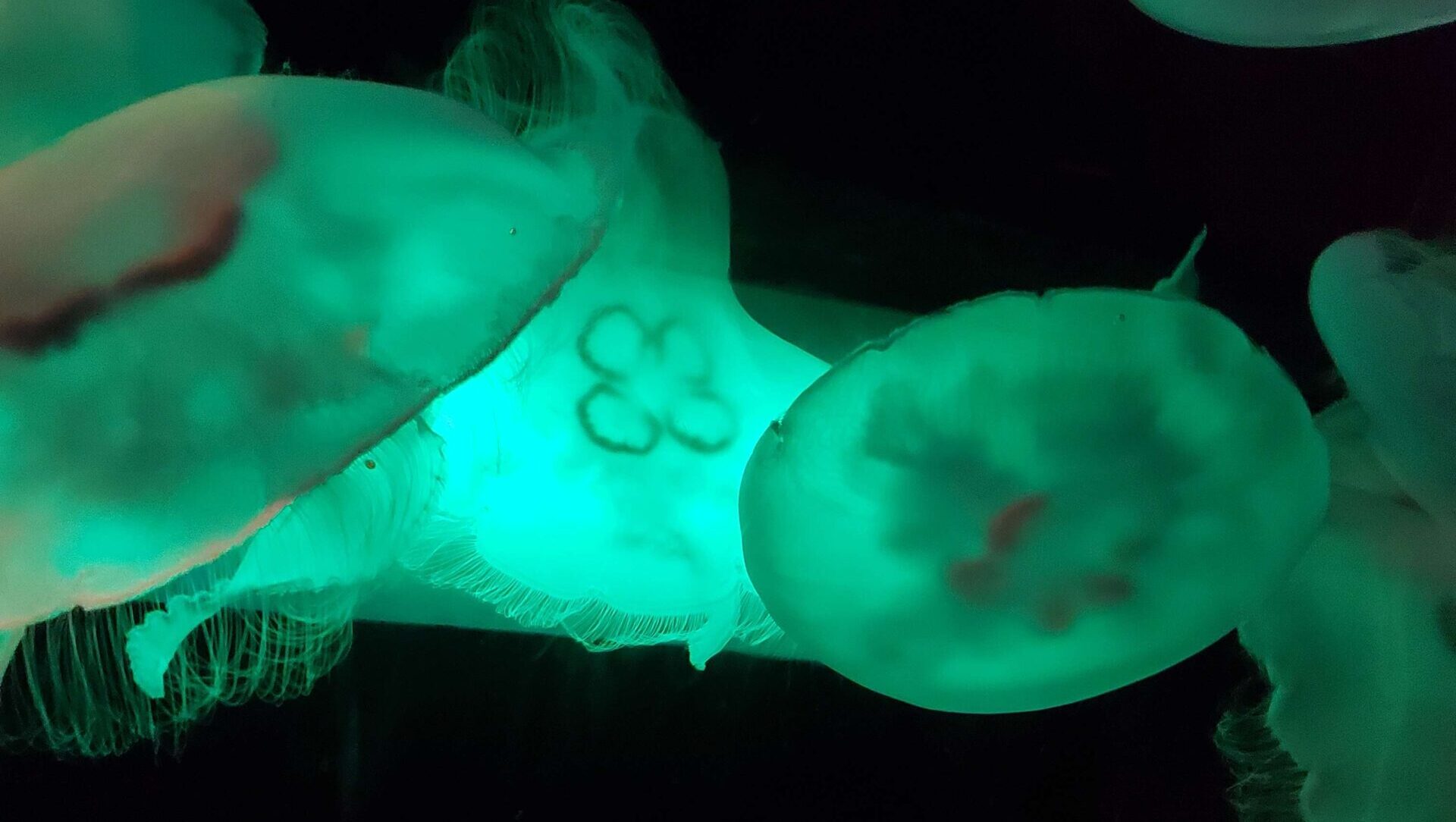
I must have been three or four. I was with my grandparents in Oregon. My grandfather stood next to me and held my hand. I remember how rough his palm felt, how much bigger it was than mine. We were at an aquarium. It must have been in Portland, but I’m not exactly certain. A tank, embedded in the wall, glowed a fluorescent blue. We stood there and watched the jellyfish—Aurelia aurita—drift like flakes of marine snow in a cerulean void. My grandfather said something, probably sharing a fact or cracking a joke, but I did not hear it. My eyes were transfixed on the jellies whose bells undulated softly and whose tentacles appeared as thin and fragile as spider’s silk. I remember thinking they looked like ghosts.
As enduringly precious as it has been to me, there exists one small problem with my recollection: this almost certainly did not happen. I did visit my grandparents often as a child, and one of these visits did include a trip to the aquarium. I did hold my grandfather’s hand and even now remember its texture, warmth, and the way his “elephant skin” (as he called it) sagged slowly back into place when he let me pinch it. I do remember looking at moon jellies. But the singular scene synthesized by these separate truths, the scene I remember, is not truth itself. These things did not happen together.
I imagine this experience is actually quite common with “first memories”, which, in reality, are accumulations of countless unconscious sensations, associations, and feelings. The conscious act to recall an earliest memory is like the recollection of a dream. Chronology, detail, and emotion blur into a gestalt of nostalgia, and this construction, a re-collection of scattered parts, remains deeply meaningful, regardless of whether or not its absurdity is made clear by further scrutiny.
I have to wonder if the water was truly that shade of blue?—if I always remembered it as such? But do such details really matter? The mistake we make, perhaps owing to the proliferation of the camera, is in believing the truth of our memories lies in the accuracy of their recollection—the degree to which, if superimposed over a photograph of the same events, that recollection would match. We are capable of this in rote memory, but the meaning of our experiences does not lie in their details. It never has. Time reminds us this by cutting away at everything until only their barest essences remain. What we remember, truthful or otherwise, is only that which is most meaningful to us.
I am not terrified by what I have forgotten, I am terrified by what I never remembered in the first place. When I look to my past to glean what remains there, all I see is a haze, colorless, that shrouds entire years with a formless pall of loneliness. I remember very little of my adolescence and less still of my present stint in adulthood. In accordance with the framework I have just detailed, this indicates that the majority of my life has been lived meaninglessly, or rather that its only meaning, the only thing I bothered to remember, is the haze itself.
I have no excuse to write this. I have no good reason. I am not an artist. I am not a writer. I am not remarkable or brilliant in the slightest. I have not suffered greatly or meaningfully. Really, I’m nobody, and I have no interesting story to tell. I feel it would be easier to bear if I did, but what is there to say of loneliness anyway? Nothing literary. It hangs over you like a shadow. It hollows you out slowly and without drama or intrigue. There are no other characters in this tale. There is no plot or setting. The degeneration of the world into something equally invisible is a sort of progression, I suppose, but a tedious, self-absorbed one. One cannot construct a narrative without resulting to fantasy, which is, in my view, just a kinder word for dishonesty. That’s the tragedy of genuine loneliness. There is no redemptive tale to be found within. Nobody will save you. It rots you away and leaves you with nothing to say about it at all.
I cannot help but feel conceited for doing so, but with no excuse, talent, or story, I will attempt it nonetheless. I will collect the pieces of myself, and I know they exist because I am still here. I will make my own memories, my own meaning.
I have learned so much in this life, and yet I understand very little. I know this, and nonetheless I write this, driven not by ambition, but by something more like weariness, as paradoxical as that may seem. I write this because I’m tired and I don’t know what else to do. There is a childish part of me that hopes, more than anything else, that I might fix this… wrongness… within me by simply giving it a name, believing quite genuinely that one could, with the right words, find a story in radio static.
I lived my life watching the jellyfish dance across glass as the world passed me by. I thought them ghosts, and I was wrong. Ghosts are not pushed with the current, carried to wherever it is they need to be. The current passes through them, unaware they were ever there at all. It passes through them until everything that once surrounded them is swept away, and they alone are left to haunt the salt and darkness.
December 25, 2024

Leave a Reply