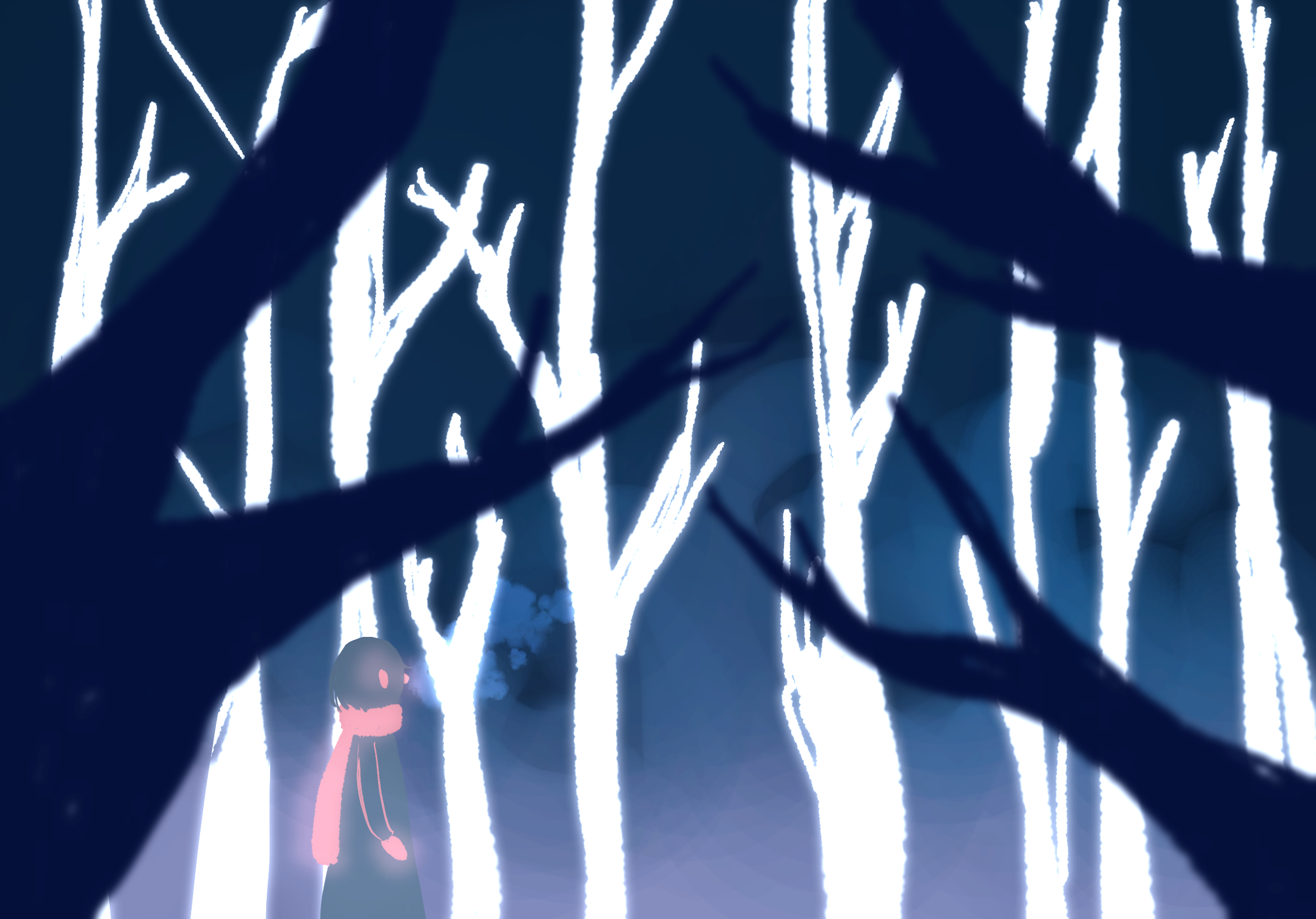
Artwork by my Summer friend, whom I hope to hug again one day.
I hate it when it gets cold.
I do not say this because I’m from Southern California, where cold weather is spoken about like a foreign war. I went to college in Utah and now live in Washington, and while I feel great nostalgia for the smokey scent of the chapparal and sagebrush in the salty coastal wind, I do not miss the endless summer of my home. My discovery of the turning of the seasons revealed to me that I had missed out on some essential quality of being human—and perhaps it is this fact that explains why Orange County is the way that it is.
After a lifetime of depression, my memory is rather fragmented, but the memories that I do possess are invariably anchored by the quality of the season they occurred in. In a rainy Seattle Fall, I remember watching a beam of empyrean light split open the clouded sky as shimmering marine mist whirled around in the cold wind. In the oppressive heat of a Tokyo Summer, I remember hugging a friend goodbye at her university, and how we both laughed after she recoiled away in surprise (or was it horror?) at the touch of my sweat-drenched back. In a cold and clear Utah Spring, I remember walking to my final class in college and seeing, more vividly than ever before, how the snow-capped Wasatch Mountains embraced the valley, and wondering, with some shame, when it was that I stopped noticing them. I remember the chill of the wind that tousled my hair and numbed my ears. I remember how the snot dribbled from my nose and how I had to wipe it away between sniffles. I remember the ache of grief that gave way to a frightening clarity. I remember thinking that I feel human only when it is time to say goodbye.
And then there is Winter without its qualifier, because I lack the ability to describe it. If Fall is a dying season, then Winter is the season for those who are already dead. My childhood friend died in the Winter (it was actually the end of Fall, but it snowed that night, so in my mind, it was in the Winter). He was eighteen, and I was nineteen. I remember it very clearly. It might be the clearest of all of my memories, as painful ones so often are. When his brother told me he was dead, my blood ran cold. My body began to shake, and I was overcome with an intense feeling of nausea, but I did not vomit. I paced around my tiny dorm room. I tried to sleep (how ridiculous!), and when it became clear that my night would not include rest, I put on my coat and went out for a walk. It was a little past 2am and freezing cold, and I shivered incessantly throughout my aimless walking. The only thing I wanted, aside from my friend to still be alive, was to cry, but the tears did not come, and my mind churned with dark, incoherent, useless thoughts. I arrived at a ditch whose slopes were blanketed in fresh, untrodden snow, and perhaps because it was the closest thing to an embrace that I could find, the narrow trough of its base, barely as long as my body, invited me to lie in it. I carefully stepped down the slope, laying on my back in the soft snow. It was painfully cold, my fingers and ears stung unbearably, and my shivering worsened until my teeth began to chatter. I lay there and watched my breath coalesce into mist that obscured the stars smothered by light pollution. I have never felt more present in my body than I did then, when it screamed at my selfish, mutineering mind to seek warmth. Its cry of pain was heard, but it was not listened to, because I—the thing that is trapped within my body—felt guilt, an enormous, suffocating guilt, at the understanding that I was still able to feel so much pain. I felt pain because I was still alive, and my friend was not. Finally, I began to cry, only a hint at first, but quickly it deepened into ugly, breathy sobs. Tears streamed down my cheeks, freezing there. God! Why did that hurt too?! I covered my face in shame, shivering, trembling, and weeping. I wished I were dead, or at least that I had died in my friend’s place, but that foolish thought made me feel more wretched. Is pain, and the capacity to feel it, not a privilege? Is it not proof that I live? How dare I wish to run away from it!
The memory ends there. Somehow, I went back to my dorm, and the following morning I apparently took a Calculus exam that I cannot recall. I think I fell out of the bus, too, and I’m pretty sure it hurt, but it doesn’t really matter if I did or not.
That was seven years ago. I have healed a lot since then, but maybe I’ve just gotten busier. Busyness frightens me more than idleness. When one is idle, they have nothing better to do than to confront their pain. Idle people understand their pain better than they understand themselves. After endless observation, they can describe its qualities with scientific precision, and there is some relief in this. For those who have suffered particularly severely, there is a tremendous risk of falling into the ever-alluring trap of believing that they are their pain, that little else of them exists besides. Even more precarious is the temptation to find some deeper meaning within the accumulation of their pain, and, spurred by the conceited hope of an artist, attempt to take that ugly, monstrous mass and refine it into something beautiful. Busy people are too busy to feel their pain, though it is still there, waiting. And when a busy person finally slows enough to notice it again, their agonies are far worse than those of the idle person, for they are less familiar with them. It is horrifying, and so they recoil away from it by getting busier, busier, until just like the idle person who has become their pain, the busy person has become their busyness.
For most of my life, I have been the idle person, and only recently have I become the busy one. Being busy is easier than being idle in the same way that being a child is easier than being an adult. I say this without judgment. After becoming busy, I have been happier. My existence has been lighter in the way it was when I was a child. I have reconnected with a curiosity and playfulness I thought was forever lost to me, and while I am immensely grateful for it, I have also found pain to be so much harder to bear. I can no longer do it with the same gracefulness I did when it was an everyday occurrence, when I walked to the execution block with my fate already accepted. Now, I dare to hope for something different.
This has produced a great dissonance within me. After my night in the ditch, I vowed to never take my pain for granted, to never run away from it. I have called this honesty, and I fear that my busyness has been dishonest—that I have used it to distract myself and run away.
Is that what this is? Running? But, like falling out of a bus, it doesn’t really matter, does it? It is getting cold again. It will always get cold again, and my haunting will continue, but that isn’t why I hate it.
I fear what I am without my idleness, and so I have sought to slow down and make myself less busy. The consequence of this is that I have spent far more time thinking about things than any reasonable person ought to. On my walks home, when it is painfully cold outside, I make myself defenseless. I let the intense pang of grief wash over me and am racked with the same guilt I felt seven years ago when I watched my breath in a ditch. It might even be worse now. I listen to the Juncos and Chickadees sing in the trees’ barren boughs. I watch the sun set from my kitchen table, staining the sky with molten hues of red, and I think it looks even more beautiful when partly obscured by clouds. I hold a warm cup of tea in my hands, sipping slowly, and I weep quietly with shame, thinking again of the way I saw the mountains on my last day of college, so full and clear and real, the way one can only see something honestly when they look back at it for the last time.
Winter does not just haunt me, it also chastises me (is a haunting not also a form of chastisement?), and I deserve it. My body feels my mind’s dishonesty. My friend died a child, and I am an ungrateful wretch who lives clumsily and forgets, through meaningless distraction, how to notice the endless, sublime beauty of the world and the inescapable, agonizing pain of loss. What an intolerable waste! I am so ashamed of myself. I am so unbearably ashamed, but I don’t want it to be any easier. In the same way I wish to always see the world’s beauty with the visceral clarity of a goodbye, I also wish to feel my pain just as deeply, for grief is love in its purest, ugliest, most honest expression. How could I deny myself of that?
I hate it when it gets cold because in every ache, pain, and discomfort, I know that I am human. I exist within a body that inherently makes me vulnerable. I make stupid mistakes and strive toward ridiculous impossibilities. I wipe the snot that dribbles from my nose while I forget every lesson I have ever learned and continue in the endless idiotic stumbling that is living. I know that one day I will die, like my friend did, but that matters even less than falling out of a bus. It changes nothing. Death will come as silently as falling snow and pass without notice, like the day I stopped seeing the mountains. I will be gone and someone who loved me will be forced to sort through the broken pieces, just as I do now. But before then, while I still live, I will strive to never lose sight of my love and my grief. I will live my life viscerally.
Honesty, I have realized, is not a refusal to run away. Distraction is as inevitable as death, and honesty is choosing to always turn back toward the center when its spell is broken. My own center—that which shatters the spell—is the cold, and I will always turn back at its call.
I hate it when it gets cold because, despite all my shame, the world embraces me like a snowy ditch and gently asks me to do something harder than living.
It asks me to forgive myself.

Leave a Reply