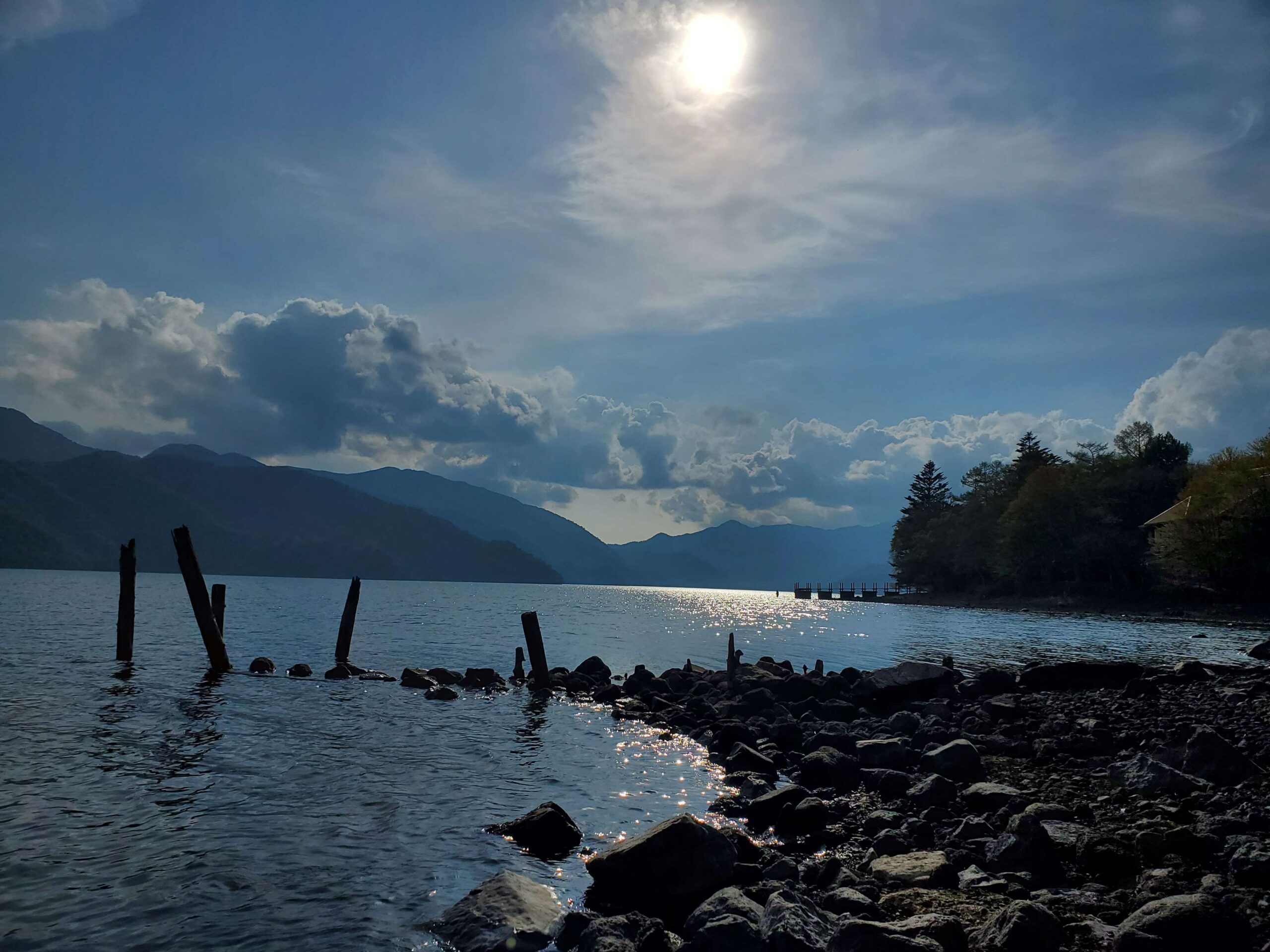
The child watched them, wide-eyed, saying nothing. Just as Sirris had said, they began to rise from the lake: translucent, amorphous creatures, as if life had been granted to the mist which gathered upon its surface on gray mornings. One by one, they drifted into the night sky, carried forth by some unseen, ordered wind which first arranged them into a singular helix, then another, another, each winding around the others, yet never intersecting.
The night erupted into color. The phantasms, woven together in a whirl of brilliant gemstones, now fluoresced with the brilliance of the stars themselves. Soundlessly, they continued their ascent until at last they seemed to scrape the firmament itself. From that distance, their light seemed so fragile, and indeed, they slowly vanished from sight until they were indistinguishable from the black void of the night sky.
Still enthralled, the child asked, “What are they doing?”
“They’re dying,” Sirris said.
Her answer left him with a dull feeling in his chest, and the emptiness between the stars seemed heavier.
The woman looked at him, her crude iron mask hiding the expression of the face that lied beneath it. Her voice had a metallic echo. “Does that make you sad?”
The child nodded solemnly.
“I suppose it is sad,” she said, and she looked toward the surface of the lake. “Phantasms are elusive creatures. They exist all around us, yet it is only in the moment of their deaths that we are able to see them. They were beautiful, weren’t they?”
“Yes,” the child said. “And they looked fragile, too—like they were made of glass.”
She rose her chained hand to her rusted chin, and her shoulders trembled briefly. If she laughed, it made no sound. “You are wise for someone so young.”
The child smiled, but it did not ease the heaviness in his heart. Sirris was right: they were beautiful, but now that beauty was gone, never to return, and all that was left was the permanence of that fact. “I wish I could have seen them for a little longer,” he said.
“I do too, but that would deny them their beauty. There are many things we can do in our time as living beings, but the most important, the most meaningful, is to die.”
He did not understand her, and when she began to talk of such things, it made him uneasy. He felt hurt. “So all the time we’ve spent together—none of that was important? None of that meant anything?”
“You misunderstand me.” Her bindings rattled as she placed her pale hand upon his shoulder. “It is because we will die that our time means anything. To die is an exquisite thing, for it is the singular confirmation of the only fact that ever was. We cannot deny it. Not any longer.”
The child looked at Sirris, his only friend, the prisoner whose face was locked away with her. He saw her frail body, her skin clinging to the bones which lied beneath it, her translucent hair that spilled out from beneath her mask, shimmering like a pearl under the light of the stars. She was weak, bound, fragile, like glass, and yet she terrified him even more than his Empyrean mother.
This was a star different than all the rest. That was why it had to be locked away. This was a star that knew it would burn out. It welcomed it. And for that, it burned all the brighter.
February 3, 2024

Leave a Reply